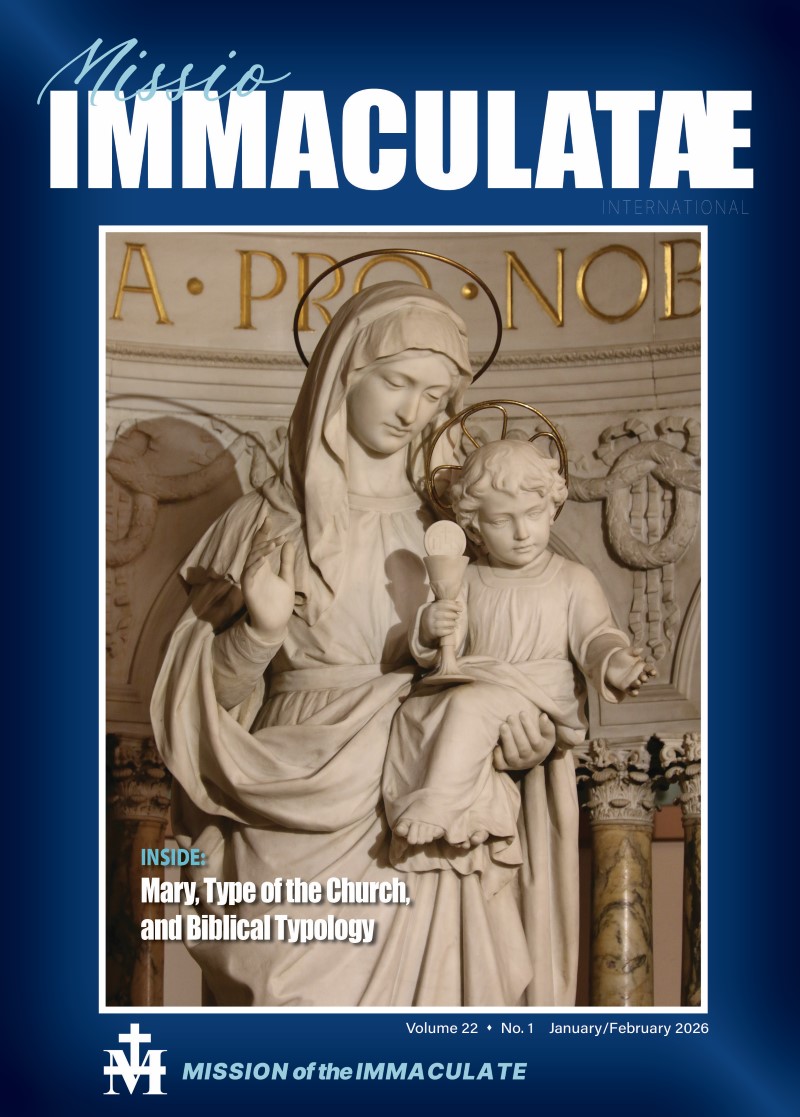
Noted Mariologist Dr. Mark Miravalle offers his reflections on what he sees as signs of promise and of hope in Pope Leo XIV’s early pontificate in regards to his understanding of Our Lady. Dr. Miravalle offers reflections and parallels to the Pope’s predecessor-by-name, Pope Leo XIII, who wrote extensively on the Blessed Mother during his pontificate.
Contemporary Mariological Decline
What has taken place in Mariology between these two Leonine popes? Since the dynamic and full Mariology of Pope Leo XIII, what has affected the notable contemporary minimalization of Mariology and its corresponding devotion?
A full Mariology of Marian coredemption and mediation continued in positive development throughout the first half of the 20th century, as illustrated by the 1958 International Lourdes Mariological Conference, whereby a strong majority of Mariologists present defended the basic doctrine of Marian coredemption and its theological and magisterial integrity.1 It was the aftermath of the controversial debates on these subjects at the Second Vatican Council and the post-conciliar Mariological tendencies that sought, out of an intended spirit of ecumenism, to minimize these classic Marian doctrines and their respective titles, which was never the explicit directive of the Council itself.2 It is not the task here to offer a substantiative treatment on the Mariological discussions during the Council and its effects on the subsequent ten years, the Marian minimalization of which has been acknowledged by theologians such as Avery Dulles, Rene Laurentin, Joseph Ratzinger, and sometimes referred to as a “decade without Mary.”3 Rather, it suffices here to simply delineate some of the reductionist theological tendencies that arose from that post-conciliar period, which to a significant degree, continue in many Mariological circles today:
1. A false understanding of ecumenism, which led not to the prayer and authentic dialogue instructed by the Council’s Unitatis Redintegatio (and later magisterial documents like St. John Paul II’s Ut Unum Sint), but rather to the minimalization or even the omission of past Mariological magisterial teachings outright.
2. A new and unfortunate biblical hermeneutic on Marian passages, bereft of the patristic and traditional exegesis, which led to conclusions that became similar to Protestant conclusions, for example, the Pauline instruction of 1 Tim 2:5 as newly interpreted to exclude any forms of subordinate and secondary mediation as participations in the one mediation of Jesus, and hence the rejection of Our Lady as “mediatrix” with the one Mediator.
3. The rejection of analogy in theological terms, and its replacement by univocal denotations, for example, that Jesus is the only Redeemer, therefore Mary cannot be called a human Coredemptrix, nor can Christians be referred to as “coredeemers in Christ,” as previously done so by Pius XI, and later repeated by Popes John Paul II and Benedict XVI.4
4. The rejection of legitimate Mariological development of doctrine and, in its place, a return to exclusively biblical terminology and initial Christian revelation as forms of a false theological primitivism.
5. A rejection of Benedict XVI’s hermeneutics of continuity5 regarding the transition before and after the Council, which perceived pre-conciliar Mariology as irrelevant (if not dangerous), and thus counterproductive to the Mariological development in the post-conciliar Church.
6. A hesitance to predicate anything about Our Lady that would not also be immediately predicated about the Church, and hence an exaggerated ecclesio-typical Mariology without its necessary and primary foundation in Christo-typical Mariology.
These and other like shifts in Mariological method after the Council, which, once again was in no explicit way explicitly directed by the Council, were valiantly countered and corrected by the inspired Mariology of St. John Paul II. Nonetheless, the later Mariological doctrine and witness of the Totus Tuus pontiff were not incorporated by a significant number of Mariologists then and even today. Moreover, these minimalist Mariological currents have led to the unfortunate influencing of a significant number of post -conciliar bishops, oftentimes unconsciously and without ill intention, to adapt a similarly compromised Mariological mindset and subsequent theological and pastoral praxes.
Remedy: The Proclamation of Marian Truth Anew
Where there has been a lessening of Marian truth, the obvious remedy is a renewed and authoritative declaration of Marian truth. Could it be the right time in the life of the Church for a solemn definition of Our Lady’s Spiritual Motherhood, inclusive of its three classic maternal components of coredemption, mediation, and advocacy?
Since the initiation of Desire Cardinal Mercier’s international Marian movement for a fifth Marian dogma well over one hundred years ago, numerous potential spiritual and ecclesial benefits have been ascribed to such a papal proclamation, which include the following:
1. the completion of Marian dogma after the four definitions of her personal prerogatives but as yet without a definition of her relation to humanity as Spiritual Mother;
2. a proper culmination to the Mariological development of doctrine revealed in Scripture, contained in the Patristic New Eve, matured through medieval and modern times, and confirmed by contemporary papal magisterium of the last three centuries;
3. a proper dogmatic foundation for classic Marian devotions, such as the Rosary, and Marian Consecration;
4. the renewed dignity of the human being and human freedom, so valued by the Father that he would make the plan of Redemption contingent on one free act of the will by one immaculate human being;
5. accentuating the full and proper role of woman and her role in the Church and the world by proclaiming the true role of the greatest Woman of Scripture, history, and humanity.6
Here, I would like to highlight three potential fruits of a fifth Marian dogma which I believe bear an immediately critical relevance to our present historical moment.
1. A Marian Response to the AI Crisis
We are presently at risk of a catastrophic moral danger: unbridled Artificial Intelligence, which threatens to replace that which defines us as human, our intellect and our will, our independent thoughts and our most important choices, if not threatening to replace God himself as the ultimate source of truth.
Artificial Intelligence is just that: artificial. It is not true human intelligence. It does not abstract. It does not derive the essence of things from external senses, internal senses, active intellect, with the passive intellect bringing forth an idea, as delineated by classic epistemology. Rather, it is programmed by algorithms, rules of data gathering and analysis, which are determined and prioritized by human beings who are oftentimes from a secular mind-set that is in direct opposition to things Christian. These programmers determine the priority of information, process, and the “ethics” of what should be prioritized and included, and what should not.
Again, human AI engineers are typically employed by global corporations whose policies are in total variance from Judeo-Christian values. And yet, many Christians are turning to AI for the most important decisions of their lives: marriage counseling between spouses; how to raise their children, and even, what religion is the best. This creeping “AI-dolatry” is gradually replacing prayer, discernment, human moral choices stemming from a Christian formed intellect and will, and even in some cases—the replacement of God himself as the ultimate source of truth for human fulfillment. Without being intrinsically evil in itself, this Tower of Babel-like replacement of artificial human knowledge for divinely revealed and humanly acquired knowledge and consequent decision-making demands serious Christian moral evaluation, followed by strict personal and societal boundaries.
To define the truth about Mary is to proclaim what it truly means to be and act as a human being. Our Lady’s example returns us to the best possible exercise of human intelligence and will, one in complete conformity to the Divine will, which is always grateful to the Divine Mind as the ultimate source of truth and love. She returns our focus to Heaven, as was her constant gaze, and to God’s plan of eternal redemption, and how humans are supported to use their intellects and wills in cooperating for human salvation, rather than a neo-gnostic replacement for human answers. St. Augustine’s maxim is best illustrated in the truth of Mary’s free and human cooperation in the Redemption: “God creates us without us, but he does not will to save us without us.”7 It is little wonder that Pope Leo has, from the start of his papacy, identified AI as one of the greatest technological challenges facing contemporary humanity.8 Moreover, Pope Leo directly refers to Our Lady as remedy to the grave dehumanizing potentials of AI in his August 4, 2025 address to the over 50,000 young people assembled at the Marian shrine of Medjugore. The Holy Father reminds the youth that “no algorithm can ever replace … a true encounter.” In corrective contrast, the Holy Father directs these young people to “think of Mary:”
Dear friends, you know well that we live in an increasingly digital world, where artificial intelligence and technology offer a thousand opportunities. Remember: no algorithm can ever substitute an embrace, a glance, a true encounter, neither with God, nor our friends, nor our family. Think of Mary. She too set out on an arduous journey to meet her cousin Elizabeth. It was not easy, but she did it, and that encounter gave rise to joy: John the Baptist rejoiced in his mother’s womb, recognizing the living presence of the Lord in the womb of the virgin Mary. Following Mary’s example, I therefore encourage you to seek out true encounters. Dear young people, as I entrust every one of you to Mary, Mother of Christ and our Mother, I accompany you with my prayers. May the Holy Virgin encourage you and guide you along the way, to become proclaimers of peace and hope.9
Beyond the exemplary value of proclaiming Mary to the world as the greatest, most fulfilled human person who exemplified the best proper exercise of human freedom, we would also receive the full exercise of her powerful maternal roles of intercession to combat the present dangers brought about through AI. To acknowledge Mary’s roles is to grant her our permission in the order of human freedom, to fully exercise her saving maternal functions on our behalf. Her titles are her functions, and to have them solemnly recognized by the highest human authority on earth, Christ’s Vicar, is to effectively bring them into full power through human consent. Thus, the Mother would be able, as never before, to fully intercede as the Mediatrix of all graces and Advocate for humanity’s return to God’s divine intelligence and love—the ultimate source of authentic Christian truth, wisdom, and peace.
1Third International Mariological Conference, Lourdes, France, 1958,https://ecommons.udayton.edu/cgi/viewcontent.cgi?article=1004&context=ml_study.
2See, for example, Laurie Olsen, Mary and the Church at Vatican II: The Untold Story of Lumen Gentium VIII, (Steubenville, Emmaus Road Publishing, 2024).
3See, Avery Dulles, “Mary Since Vatican II: Decline and Recovery,” Marian Studies, 53, (2002), 9-22; https://ecommons.udayton.edu/marian_studies/vol53/iss1/5/?utm_source=ecommons.udayton.edu%2Fmarian_studies%2Fvol53%2Fiss1%2F5&utm_medium=PDF&utm_campaign=PDFCoverPages.
4For examples of St. John Paul II references to Mary as Coredemptrix, see Pope St. John Paul II, Allocution to the Sick at the Hospital of the Brothers of St. John of God, April 5, 1981, L’Osservatore Romano, English ed., April 13, 1981, p. 6; Address to the Sick following General Audience, January13, 1982, Inseg. V/1, 1982, 91; Address to the Bishops of Uruguay, May 8, 1988, L’Osservatore Romano, English ed., May 30, 1988, p. 4.
5Pope Benedict XVI Address to Roman Curia, December 22, 2005, https://www.vatican.va/content/benedict-xvi/en/speeches/2005/december/documents/hf_ben_xvi_spe_20051222_roman-curia.html.
6Cf. for example, Fr. Peter Damian Fehlner, The Time Is Ripe For A Fifth Marian Dogma, https://www.motherofallpeoples.com/post/why-the-time-is-ripe-for-the-fifth-marian-dogma-1 M. Miravalle, Seven Reasons to Declare A new Marian Dogma Now, https://www.motherofallpeoples.com/post/7-reasons-to-declare-a-new-marian-dogma-now.
7 St. Augustine, Sermo 169,11,13 😛 L 38,923.