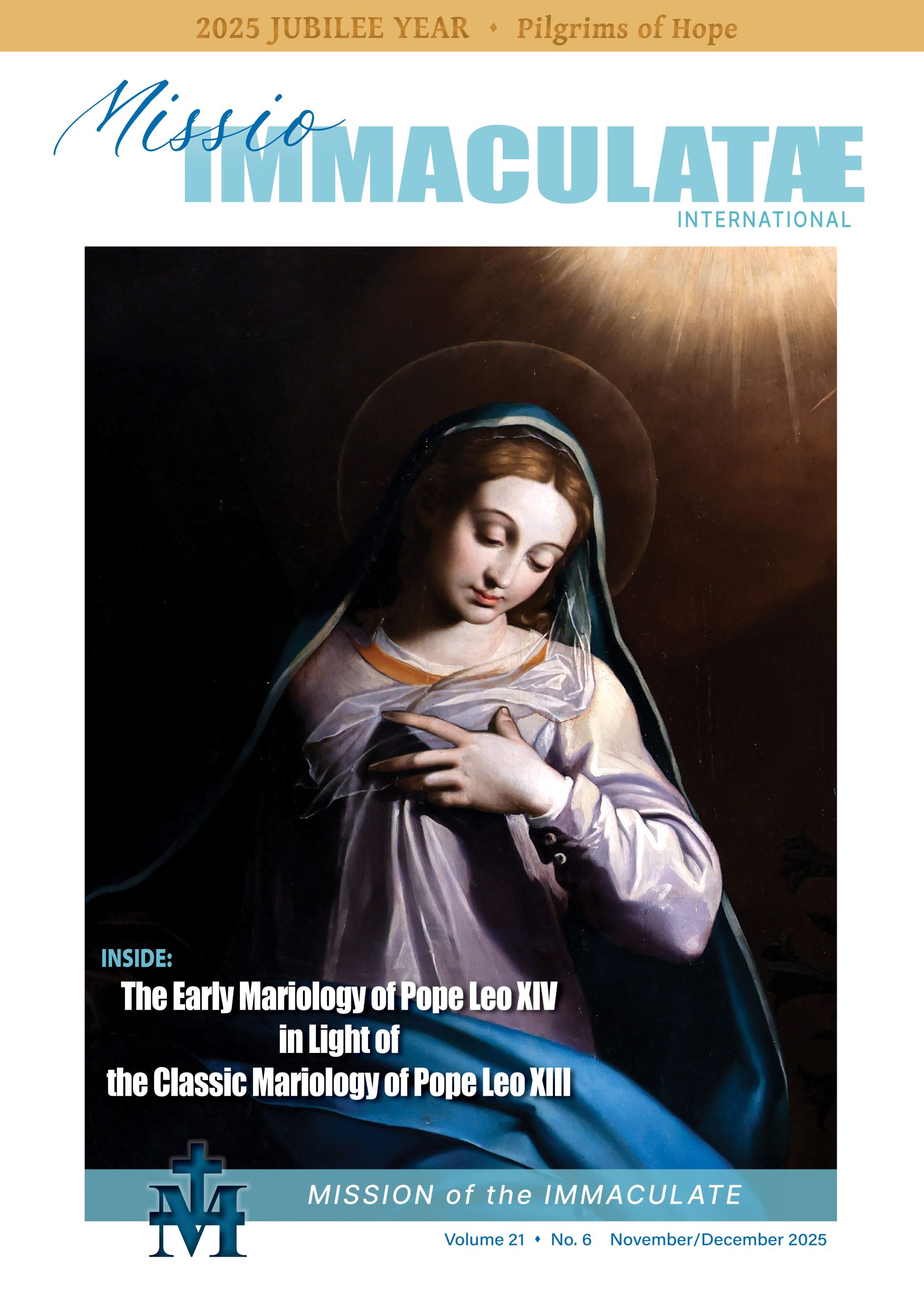
Noted Mariologist Dr. Mark Miravalle offers his reflections on what he sees as signs of promise and of hope in Pope Leo XIV’s early pontificate in regards to his understanding of Our Lady. Dr. Miravalle offers reflections and parallels to the Pope’s predecessor-by-name, Pope Leo XIII, who wrote extensively on the Blessed Mother during his pontificate.
Since the election of Pope Leo XIV, our new Holy Father has been associated with a number of significant Marian teachings and events, both providential and by his own initiative.
On the day of his election, May 8, 2025, his opening words contained this heartfelt Marian witness:
Today is the day of the Prayer of Supplication to Our Lady of Pompeii. Our Mother Mary always wants to walk at our side, to remain close to us, to help us with her intercession and her love. So I would like to pray together with you. Let us pray together for this new mission, for the whole Church, for peace in the world, and let us ask Mary, our Mother, for this special grace, Hail Mary …1
In fact, Pope Leo was elected on May 8, the feast of the Supplication of Our Lady of the Rosary, which stems from the great Marian devotion and evangelization of Blessed Bartolo Longo, to be canonized on October 19, 2025. May 8 has also been celebrated as the feast of Mary, Mediatrix of Graces by several religious communities (i.e., Dominican Missal of 1960), as well as the Feast of Mary as Mediatrix of All Graces in the 1962 Missal issued by Pope St. John XXIII.2 Moreover, May 8 has been celebrated perennially as Our Lady of Grace by the Augustinian order, of which Pope Leo is a member.
On May 9, the second day of his papacy, Pope Leo offered the Mass for the College of Cardinals, as is custom. In his homily, the pontiff compares the proper exercise of “a ministry of authority” with Christian martyrdom as exemplified by St. Ignatius of Antioch, and the “indispensable commitment” to “move aside so that Christ may remain, to make oneself small so that he may be made known and glorified, to spend oneself to the utmost so that all may have the opportunity to know and love him.” The Pope then concluded by petitioning for this grace personally through the intercession of Our Lady: “May God grant me this grace, today and always, through the loving intercession of Mary, Mother of the Church.”3
On his third day as pope, Saturday, May 10 (technically his first day off from officially scheduled events), Pope Leo visited not one, but two Marian shrines. Along with a visit to St. Mary Major’s Basilica and prayer before the revered Salus Populi Romani image, the pontiff travelled some 30 kilometers outside of Rome on personal pilgrimage to the Shrine of the Mother of Good Counsel in Genazzano, one very close to the pope’s heart.
Upon entering the Shrine, the Holy Father penned the following personal message into the guestbook, which describes his sense of “duty and deep longing” to come and thank his Mother for her help, and to request her maternal presence for his new mission as pope:
Still in the first days of the pontificate, I felt the duty and a deep longing to approach Genazzano, the shrine of Our Lady of Good Counsel, who, throughout my life, has accompanied me with her maternal
presence, with her wisdom, and the example of her love for her son who is always the center of my faith. Way, truth and life. Thank you, Mother, for your help—accompany me in this new mission.— Leo PP XIV May 10, 20254
As he exited the Shrine, numerous locals cheered him, to which he briefly stated, “As the Mother never abandons her children, you must also be faithful to the Mother.” The people then began chanting, “Viva il Papa!” to which Pope Leo responded, “Viva Maria!”5
On Sunday, May 11, during his first Regina Caeli address, Leo again refers to Our Lady: “May the Virgin Mary, whose entire life was a response to the Lord’s call, always accompany us in following Jesus.”6 In his comments immediately following the Regina Caeli, the Holy Father referred to the grave conflicts between Russia and Ukraine, Israel and Iran, India and Pakistan, and others. He then entrusted these places to Mary, Queen of Peace in order to obtain a “miracle of peace”: “But how many other conflicts there are in the world! I entrust this heartfelt appeal to the Queen of Peace, so that she may present it to the Lord Jesus to obtain for us the miracle of peace.”7
On the same day, the Vatican officially released Leo’s new coat of arms. With only minor adjustments from his episcopal coat of arms, the Roman pontiff dedicates half of his papal image to Our Lady, with a Marian blue field on the top left half and the fleur de lis, the Marian flos florum, symbolic of Our Lady’s purity, virginity, and queenship, in the center of the Marian blue.8
In comments following his first General Audience of May 21, 2025, Pope Leo asked both Portuguese and Arab speaking pilgrims not to “close their hearts” to Our Lady of Fatima’s call to “pray the Rosary every day for peace”: “In this Marian month, I would like to confirm the invitation of the Virgin of Fatima: ‘Pray the Rosary every day for peace.’ Together with Mary, we ask that peoples do not close themselves to this gift of God and disarm our hearts.”9
In his June 9, 2025 homily for the memorial of Mary, Mother of the Church, Pope Leo presents an outstanding Marian tribute, which includes arguably the strongest single line on Marian coredemption since the pontificate of St. John Paul II. He refers to Our Lady as the “New Eve” at Calvary, because her Son “associated her with his redemptive death”: “Mary’s motherhood through the mystery of the Cross took an unimaginable leap: the mother of Jesus became the new Eve, the source of new and eternal life for every person who comes into the world, because her Son associated her with his redemptive death.”10
Rightly attributing the New Eve title and role to Our Lady at Calvary bespeaks her proximate, immediate role with Jesus in the Redemption, rather than merely a remote, mediate interpretation of the New Eve by her fiat at the Annunciation. The pope’s testimony that Jesus “associated her in his redemptive death” can only mean Mary’s direct and secondary causal participation in the Redemption wrought by Christ. This represents a clear papal teaching of Marian coredemption at Calvary.
It should be noted that the official English translation slightly strays from the original Italian, which reads, “La maternita di Maria attraverso il mistero della Croce ha fatto un salto impensabile: la madre di Gesu e diventata la nuova Eva, perche il Figlio l’ha associata alla sua morte redentrice, fonte di vita nuova ed eterna per ogni uomo che viene a questo mondo.” This is more accurately translated, “The motherhood of Mary through the mystery of the Cross made an unimaginable leap: the Mother of Jesus became the New Eve, because the Son associated her in his redemptive death, the source of new and eternal life who comes into this world.” The word order of the official English translation could suggest that Mary as New Eve is the source of new and eternal life, rather than the redemptive death of Jesus, which does not appear to be intended in the original Italian.
In the same homily, our new Holy Father speaks of how we as the Church manifest our fruitfulness as Mary “in miniature”: “The fruitfulness of the Church is the same fruitfulness as Mary’s; it is realized in the lives of her members to the extent that they relive, ‘in miniature,’ what the Mother lived, namely, they love according to the love of Jesus.”11
Note the refreshing distinction between Mary’s superior spiritual fecundity, and the Church’s participation as Mary, but clearly in miniature. This rightly acknowledges the subordinate way in which the People of God cooperate in the spiritual productivity of Christ compared to that of the Mother. In light of the recent Mariological trend which oftentimes equates the spiritual value of the role of Mary to that of the Church, Pope Leo’s appropriate reference to this Marian primacy is appreciated.
Pope Leo then proceeds to confirm Our Lady’s maternal mission at Pentecost as an extension of her coredemptive role at Calvary: “In the Upper Room, thanks to the maternal mission she received at the foot of the cross, Mary is at the service of the nascent community: she is the living memory of Jesus and, as such, she is the center of attention that harmonizes differences and ensures the unity of the disciples’ prayer.”12
Further, the Holy Father recognizes Our Lady as the first to support the Petrine office in Peter (which logically bears witness to Leo’s belief in the Mother’s support for his newly acquired office). Moreover, he acknowledges the primacy of the “Marian pole” to the “Petrine pole” in the Church, with the dependency of the latter on the former for its spiritual efficacy and holiness:
In this text too, the apostles are listed by name and, as always, Peter is the first (cf. v. 13). But he himself, in truth, is the first to be supported by Mary in his ministry. In the same way, Mother Church supports the ministry of Peter’s successors with the Marian charism. The Holy See experiences in a very special way the coexistence of the two poles; the Marian and the Petrine. It is precisely the Marian pole, with its motherhood, gift of Christ and of the Spirit, that ensures the fruitfulness and holiness of the Petrine pole.13
In Continuity with the Mariology of Pope Leo XIII?
During his May 10 address to the College of Cardinals, Pope Leo explained why he had chosen the name “Leo” as his papal nomenclature. He stated there were “different reasons,” along with the principal reason of Leo XIII’s battle for human rights during the 19th century Industrial Revolution, and the similar need to advocate for human dignity during the present rise of Artificial Intelligence.14 Is it also possible that the present pontiff could follow the path of his predecessor’s great Mariological teachings? Let us here briefly examine a sampling of Pope Leo XIII’s rich Marian doctrine, which possesses a particular accent on Marian coredemption and mediation.
During the time of the grave Church crises of the later part of the 19th century and entering into the 20th, Leo XIII wrote no less than eleven encyclicals directly on the Rosary, wherein we find his principal Mariological instruction. Through this series of inspirational encyclicals, we find not only the consistent doctrinal teaching on the unique role of the Mother in redemption and her subsequent role as the mediatrix of all graces, but also an unequivocal recognition of her providential role as the God-appointed remedy for the ubiquitous onslaught of spiritual, social and moral attacks on the Church, brought on by the likes of the Enlightenment’s tragic offspring: Marxism, Darwinism, Liberalism, Communism, Freemasonry, as well as unchecked laissez-faire Capitalism.
Regarding Our Lady’s unique cooperation with and
under Jesus in the historic redemption of humanity, otherwise known as Marian coredemption, we find significant Leonine references. For example, in his encyclical, lucunda Semper (1894), we see the well-known passage testifying to Our Lady’s coredemptive offering of Jesus to the Father, united to her own self-offering, which happens first at the temple where she is already “sharing in the painful atonement” of human redemption, but also ultimately at Calvary where she experiences a “death of heart” in union with her redeeming Son:
When Mary offered herself completely to God together with her Son in the temple, she was already sharing with Him the painful atonement on behalf of the human race. It is certain, therefore, that she suffered in the very depths of her soul with His most bitter sufferings and with His torments. Moreover, it was before the eyes of Mary that was to be finished the Divine Sacrifice for which she had borne and brought up the Victim. As we contemplate Him in the last and most piteous of those Mysteries, there stood by the Cross of Jesus His Mother, who, in a miracle of charity, so that she might receive us as her sons, offered generously to Divine Justice her own Son, and died in her heart with Him, stabbed with the sword of sorrow.15
In his encyclical, Adjutricem Populi (1895), Leo XIII refers to Our Lady with the title of “Reparatrix of the whole world.”16 The Reparatrix title denotes Mary’s unique participation with Christ in the repairing of the relationship between God and humanity, the New Eve in union with the New Adam, which has too long been undervalued for its full coredemptive value. Not only does it include Mary’s remote cooperation in redemption at the Annunciation, but also her proximate participation at Calvary. To cooperate in the restoration of the covenant between God and the human race which is only fully effected at Gologtha, is to attribute to the Mother an immediate historic role in the objective redemption wrought by Jesus, and not only a distant mediate role at the Annunciation.
In the same encyclical, Leo XIII refers to Mary’s role as a “cooperatrix in the sacrament of man’s redemption,” which constitutes yet another title of coredemptive status. He then alludes to her unique coredemption as the foundation for her subsequent role in the distribution of all grace: “She who had been the cooperatrix (cooperatrice, Italian) in the sacrament of man’s redemption would be likewise the cooperatrix in the dispensation of graces deriving from it.”17
In the Leonine encyclical, Magnae Dei Matris, (1892), Our Lady receives an unparalleled creaturely glory in virtue of her coredemptive role as Queen of Martyrs, because “she will drink” with the Redeemer “the cup overflowing with sorrow, faithfully through all her life, most faithfully on Calvary”:
Her sacred promise (fiat) was as sacredly kept with a joyous heart; henceforth she leads a life in perpetual union with her son Jesus, sharing with Him His joys and sorrows. It is thus that she will reach a height of glory granted to no other creature, whether human or angelic, because no one will receive a reward for virtue to be compared with hers; it is thus that the crown of the kingdoms of heaven and of earth will await her because she will be the invincible Queen of Martyrs. It is thus that she will be seated in the heavenly city of God by the side of her Son, crowned for all eternity, because she will drink with Him the cup overflowing with sorrow, faithfully through all her life, most faithfully on Calvary.18
This ordinary Magisterium’s teaching of Mary’s unparalleled eternal reward and glory stems first and foremost from her lifetime sharing with the suffering of her Son, which again reaches its culmination on Golgotha.
Extremely significant is the fact that Leo XIII is the first pope to grant papal approval to the Marian title, “Co-redemptrix.” While in audience with the Secretary of the Congregation of Indulgences, Msgr. Francisco Vours, Leo XIII approved the “Laus Mariae Virginis,” (Praise of the Virgin Mary) which included a litany of Mary invoking her as “Coredemptrix of the world” [Italian, Corredentrice del Mondo, Latin, Mundo redimendo coadiutrix].19
In sum, Leo XIV’s nominal predecessor confidently and repeatedly taught Marian coredemption as a constitutive foundation of his official Marian magisterium.
In terms of Mary’s mediation as it pertains to the distribution of the graces of Christ’s redemption, Leo XIII repeatedly taught Mary as the “Mediatrix of all graces.” In the encyclical, Octobri Mense (1891), the 19th century pontiff offers the following classic Marian teaching that “nothing of the immense treasure of every grace … comes to us except through the Mother’s mediation, and connects this truth with the level of assent worthy of “divine faith”:
With equal truth it can be affirmed that, by the will of God, nothing of the immense treasure of every grace which the Lord has accumulated, comes to us except through Mary (dell’immenso tesoro di ogni grazia recatoci da Cristo … niente assolutamente [nihil prorsus] viene a noi comunicato … se non per mezzo di Maria). Thus as no man goes to the Father but by the Son, so, typically, no man goes to Christ but by his Mother…. How great are the wisdom and mercy revealed in this design of God … Mary is our glorious intermediary; she is the powerful Mother of the omnipotent God. All the Christian peoples of every age accepted this unanimously. There is no other reason for this than a divine faith (Italian: fede divina, Latin: ex divina fide).20
In the encyclical, Supremi Apostolatus (1883), Leo XIII denotes Our Lady as the “Treasurer of our peace with God and dispensatrix of heavenly graces.”21 In Superiore Anno (1884), the pope identifies Mary as the maternal means “through whom he [God] has chosen to be dispenser of all heavenly graces.”22 Moreover, in the encyclical, Jucunda Semper (1894), Leo quotes St. Bernadine of Siena’s well-known description of the three modalities by which graces flow from the God the Father to humanity, and the providential mediation of the Virgin Mediatrix: “Thus is confirmed that law of merciful mediation of which we have spoken, and which St. Bernadine of Siena thus expresses: ‘Every grace granted to man has three degrees in order: for by God it is communicated to Christ, from Christ to the Virgin, and from the Virgin it descends to us.'”23
Not only does Leo XIII repeatedly teach the doctrine Our Lady as Mediatrix or Dispensatrix of graces, as witnessed in these texts, but he also officially and emphatically teaches her role as the Mediatrix of all graces. True Marian doctrinal development, as guided by the Spirit and pronounced by Peter, cannot regress but only progress. So, too, will this be for the Church’s perennial teaching on the Marian mediation of all graces as a consequence of her coredemption.
What of our Mother’s role as the universal interceding Advocate for the Church and world? Here, too, Leo XIII provided light and truth. Again from his encyclical, Magnae Dei Matris, Leo XIII writes: “Throughout the many dreadful events of every kind which the times have brought to pass, always with her have we sought refuge, always to her have we lifted up pleading and confident eyes. And in all the hopes and fears, the joys and sorrows, that we confided to her, the thought was constantly before us to ask her to assist us at all times as our gracious Mother.”24
Leo XIII, moreover, assisted in establishing the precedent for the global consecration later requested by Our Lady at Fatima through his antecedent consecration of the world to the Sacred Heart in 1899 as promulgated in the papal document, Annum Sacrum.25 It was also Leo XIII who, along with preparing the world for the great challenges of the 20th century by highlighting the Rosary, further received in a mystical experience during Mass the prayer of St. Michael the Archangel, revealed to him on October 13, 1884. This day would later become the same day upon which the renowned Fatima solar miracle would take place in 1917.26 Clearly, this pontiff understood the spiritual warfare he was facing as Peter’s successor, and that only a spiritual remedy would ultimately be effective in the upcoming 20th and 21st centuries’ cosmic battle for souls.
Let us again reference Adjutricem Populi, Leo XIII and his testimony of the power of Our Lady’s advocacy for the world (noting its obvious relevance to our own present historic situation):
It is impossible to measure the power and scope of her offices since the day she was taken up to that height of heavenly glory in the company of her Son, to which the dignity and luster of her merits entitle her. From her heavenly abode she began, by God’s decree, to watch over the Church, to assist and befriend us as our Mother … The power thus put into her hands is all but unlimited. How unerringly right, then, are Christian souls when they turn to Mary for help .”27
In sum, Leo XIII understood that Our Lady is the God-appointed remedy for the ubiquitous woes which face the Church in any given age, nor did he hesitate to identify her Spiritual Maternity as manifest through her powerful maternal roles of Coredemption, Mediation, and Advocacy.
Could it be suggested that a similar Marian path may be historically fruitful by our present Holy Father?
1Opening comments of Pope Leo XIV after his election, May 8, 2025, Vatican News,
www.vaticannews.va/en/pope/news/2025-05/pope-leo-xvi-peace-be-with-you-first-words.html.
2Fr. Neil Roy, “Mary and the Liturgical Year,” in Mariology: A Guide for Priests, Deacons, Seminarians, and Consecrated Persons, ed. Mark Miravalle (Queenship Publishing, 2007), 652.
3Pope Leo XIV, Homily to the College of Cardinals, May 9, 2025, Vatican New Service,
www.catholicnewsagency.com/news/264037/i-wanted-so-much-to-come-here-pope-leo-visits-marian-shrine-outside-of-rome.
4Pope Leo XIV, Visit to the Mother of Good Counsel Shrine, Genazanno, Italy, May 10, 2025, www.rorate-caeli.blogspot.com/2025/05/leo-xiii-to-lady-of-good-counsel.html.
5Pope Leo XIV, Comments upon leaving the Mother of Good Counsel Shrine, Genazzano, Italy, www.catholicnewsagency.com/news/264037/i-wanted-so-much-to-come-here-pope-leo-visits-marian-shrine-outside-of-rome.
6Pope Leo XIV, Regina Caeli Address, May 10, 2025, www.vatican.va/content/leo-xiv/en/angelus/2025/documents/20250511-regina-caeli.html.
7Ibid.
8Pope Leo XIV, Papal Coat of Arms, May 10, 2025,
www.vaticannews.va/en/pope/news/2025-05/pope-leo-xiv-s-motto-and-coat-of-arms.html.
9Pope Leo XIV, Comments Following General Audience of May 21, 2025 to Portuguese and Arab speaking pilgrims, https://press.vatican.va/content/salastampa/en/bollettino/pubblico/2025/05/21/250521c.html (Author’s English translation). Original Italian: “In questo mese mariano, vorrei ribadire l’invito della Vergine di Fatima: «pregate il rosario ogni giorno per la pace». Insieme a Maria, chiediamo che gli uomini non si chiudano a questo dono di Dio e disarmino il loro cuore.”
10Pope Leo XIV, Homily for the Mass of Mary, Mother of the Church, June 9, 2025,
www.vatican.va/content/leo-xiv/en/homilies/2025/documents/20250609-omelia-giubileo-santa-sede.html.
11Ibid.
12Ibid.
13Ibid.
14Pope Leo XIV, Address to the College of Cardinals, May 9, 2025,
www.vatican.va/content/leo-xiv/en/speeches/2025/may/documents/20250510-collegio-cardinalizio.html.
15Pope Leo XIII, Encyclical, Iucunda Semper Expectatione, 1894, n. 3, Acta Sanctae Sedis (ASS), v. 28, p. 130.
16Pope Leo XIII, Encyclical, Adjutricem populi, 1895, n. 7, ASS, v. 28, pp. 130-131.
17Ibid.
18Pope Leo XIII, Encyclical, Magnae Dei Matris (1892), www.vatican.va/content/leo-xiii/en/encyclicals/documents/hf_l-xiii_enc_08091892_magnae-dei-matris.html.
19Pope Leo XIII in audience with Msgr. Francisco Vours, Secretary of the Congregation of Indulgence, Approval of Indulgence of Litany to Jesus and Mary, Acta Sanctae Sedis, (ASS), vol 18, pp. 92-93.
20Pope Leo XIII, Encyclical, Octobri Mense (1891), ASS, 24, 1891, 195-196 (translation in part by Doheny-Kelly, Papal Documents on Mary, Bruce, 1954, quoted by Armand Robichaud, “Mary, Dispensatrix of All Graces,” Carol, ed., Mariology, 1957, Bruce, vol 2, p. 430; in union with author’s translation from the Italian).
21Pope Leo XIII, Encyclical, Supremi Apostolatus, September 1, 1883, www.vatican.va/content/leo-xiii/en/encyclicals/documents/hf_l-xiii_enc_01091883_supremi-apostolatus-officio.html.
22Pope Leo XIII, Encyclical, Superiore Anno, August 30, 1884, www.vatican.va/content/leo-xiii/en/encyclicals/documents/hf_l-xiii_enc_30081884_superiore-anno.html.
23Pope Leo XIII, Encyclical Jucunda Semper, 1894,
www.vatican.va/content/leo-xiii/en/encyclicals/documents/hf_l-xiii_enc_08091894_iucunda-semper-expectatione.html cf., St. Bernadine of Siena, Serm in Nativit, B.V.M., n. 6.
24Pope Leo XIII, Encyclical, Magnae Dei Matris, 1892,
www.vatican.va/content/leo-xiii/en/encyclicals/documents/hf_l-xiii_enc_08091892_magnae-dei-matris.html.
25Pope Leo XIII, Annum Sacrum, May 25, 1899,
www.vatican.va/content/leo-xiii/en/encyclicals/documents/hf_l-xiii_enc_25051899_annum-sacrum.html.
26There are different reports of the mystical experience or vision of Leo XIII that led to his composition of the Prayer to St. Michael the Archangel. Some say the vision occurred during Mass and others say it happened after celebrating Mass. See Kevin Symonds, Pope Leo and the Prayer to St. Michael (Boonville, NY: Preserving Christian Publications, 2018).
27Pope Leo XIII, Encyclical, Adjutricem Populi, 1895, n. 7, ASS, 28, pp. 130-131),
www.vatican.va/content/leo-xiii/en/encyclicals/documents/hf_l-xiii_enc_05091895_adiutricem.html.